

NEW AI Ethics Guide for Lawyers
The Ohio Board of Professional Conduct’s Artificial Intelligence for Lawyers and Judicial Officers Ethics Guide was released May 1, 2026 and providing practical guidance for the practice of law and how to navigate this evolving landscape.

The Ohio Board of Professional Conduct’s Artificial Intelligence for Lawyers and Judicial Officers Ethics Guide
While the guide is nonbinding, it reflects the types of questions Ohio lawyers are actively asking and more importantly, highlights how existing ethical rules apply to generative AI. Ohio Bd. of Prof. Conduct, Artificial Intelligence for Lawyers and Judicial Officers, Ohio Ethics Guide, at 1 (2026). The Ohio Board of Professional Conduct gives advice for all AI usage, including but not limited to, calendar tools, intake, summarizing documents, legal research, and drafting.
At its core, the guide makes one thing clear: AI is not prohibited in legal practice. But it must be used thoughtfully, competently, and within the bounds of existing professional obligations. “A lawyer must always check, and keep abreast of any rules, orders or other court procedures implemented in the jurisdiction in which the lawyer is practicing.” Id. at 7.
Here are the highlights for attorneys:
1. Competence and Understanding the Technology
Rule: Prof. Cond. R. 1.1 (Competence)
AI is now considered a “relevant technology” in the practice of law. Id. at 2. That means attorneys have a duty to understand, or work with someone who understands, both its capabilities and its limitations. Blind reliance was never an option, but now it is clear that not understanding the limitations of an AI system will not mitigate any ethical violations that arise from incorrect usage. Lawyers must verify outputs, particularly when it comes to legal citations, factual assertions, and analysis. Id. While AI usage is not required, awareness of AI is. Id.
Advice from Koblentz, Penvose & Froning: While not everyone will be equal when it comes to understanding and using AI, all practices should have some understanding. Even if an individual practice is not utilizing AI services, clients are.
2. Client Confidentiality Risks
Rule: Prof. Cond. R. 1.6 (Confidentiality of Information)
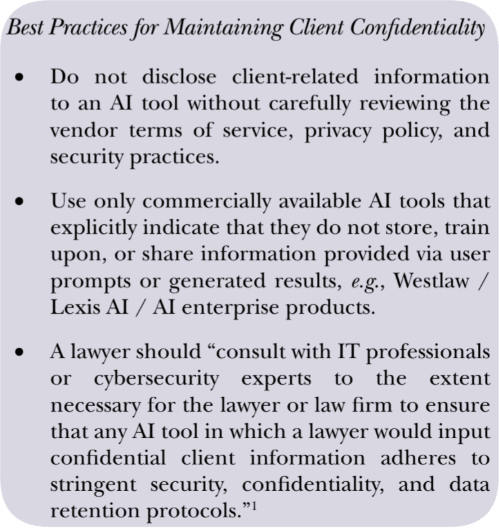
One of the most immediate concerns is how AI tools handle data. Many platforms retain or use user inputs to train their models, which can create serious confidentiality risks. Id. at 3. The guide emphasizes careful review of vendor terms, safeguarding data, and client consent before using AI tools.
Most notably, the guide says to ALWAYS ANONYMIZE client information, no matter the AI tool being used. Id.
3. Communication with Clients
Rule: Prof. Cond. R. 1.4 (Communication)
AI use is not always required to be disclosed but it may be required when it materially affects representation, billing, or how work is performed. Id. at 4. For example, if the original drafting process is shifted to AI, that should be disclosed. Lawyers must also respond to client inquiries about AI use and explain risks and benefits when relevant. If a client asks for AI not to be used in their representation, lawyers have to honor that request. Id.
Advice from Koblentz, Penvose & Froning: Have an AI provision in engagement letters and fee agreements if you are using AI services. This can help clients understand AI usage in their case and their own usage of AI and how it can affect their case, mainly the lack of attorney-client confidentiality with AI.
4. Independent Professional Judgment
Rule: Prof. Cond. R. 2.1 (Advisor)
AI can assist, but it cannot replace legal judgment. Id. at 5. The responsibility for advice, strategy, and final work product always remains with the attorney. Overreliance, especially by less experienced lawyers, can interfere with a lawyer’s duty to exercise independent professional judgment. AI should only be the starting point with task like drafting and research, “human in the loop” is not enough. Id.
“The experience level of the lawyer, his or her knowledge of the area of law, and the understanding of the limitations of AI tools, will largely determine the extent to which the lawyer may rely on AI generated output.” Id. at 5.
5. Accuracy and “Hallucinations”
Rules: Prof. Cond. R. 3.3 (Candor Toward the Tribunal), 3.1 (Meritorious Claims and Contentions), 1.1 & 1.3 (Competence and Diligence), 8.4(c)–(d) (Misconduct)
Perhaps the most widely discussed risk is AI-generated inaccuracies. Courts across the country have already sanctioned attorneys for submitting filings containing fabricated citations. Lawyers must independently verify all AI-generated content and correct any false statements to the tribunal if discovered.
AI tools are predictive models, they do not “learn” they find patterns and repeat those patterns in a way that is sold to AI users as “learning.” Id. at 6. The guide also makes a point of saying legal research should not be done on general and publicly accessible AI tools given the current state of the technology. Id. at 6.
“Lawyers assume full responsibility for ensuring that the court filings are accurate, non-misleading, and grounded in law and fact.” Id. at 6. Including hallucinations in filings would appropriately be deemed frivolous. Id.
6. Fees and Billing Considerations
Rule: Prof. Cond. R. 1.5 (Fees)
Efficiency gains from AI should benefit the client. Id. at 5. Lawyers can only bill for the amount of time a project actually takes, not what it would have taken without AI assistance. Even when charging a non-hourly based fee, flat or otherwise, the fee must still be reasonable. Additionally, in most cases, AI tools are considered overhead unless tied to specific, disclosed expenses. Id.
7. Supervision and Responsibility
Rules: Prof. Cond. R. 5.1 (Supervisory Lawyers) & 5.3 (Responsibilities Regarding Nonlawyer Assistance)
Using AI is functionally similar to delegating work to a nonlawyer assistant or third-party vendor. Lawyers must supervise its use, implement policies, and ensure compliance with ethical obligations, particularly around confidentiality and accuracy. AI tools should be analyzed to determine if their systems are appropriate to maintain the lawyer’s ethical obligations.
The Bottom Line
The Ethics Guide does not discourage the use of AI, in fact, it recognizes its potential to improve efficiency and consistency in legal work. But it draws a firm boundary: AI is a tool, not a substitute for professional responsibility.
For Ohio lawyers, the message is clear, embrace the technology, but do so with caution, competence, and oversight.
As the use of artificial intelligence continues to evolve, so too will the ethical considerations surrounding it. If you have questions about how these rules apply to your practice, we encourage you to contact experienced ethics counsel for guidance.